Bandcamp link: Buy/Stream the album here.
I’ll be honest, I’m not listening to albums front-to-back as much as I used to. It’s not so much about time; I have a fourty-minute commute, which is long enough for most. I go running a few times a week. I hike, I sit with coffee and wait to wake up properly, I take one-hour lunch breaks. Truth is, like a lot of people these days, I’m at the point where I don’t always have the attention span required. It’s sad, I know. I teach university students, whose attention spans are far more diminished than mine, and we’re all in trouble – ‘cooked,’ they might say. I’m not on TikTok, I’m not an Instagram reels kind of guy, I can watch a movie without simultaneously using my phone, but my mind still drifts. Reasons for that, I’m not so clear on, but that’s not really what this review is about.
Anyway, when it comes to Laura Stevenson’s seventh full-length album, Late Great, the highest compliment I can pay it, truly, is that it held my attention from start to finish. Not only held, but had me transfixed. It’s a quality Stevenson’s music often has, and is not limited only to her most recent album. Perhaps it’s a sad inditement of modern media that this seems praise-worthy at all [it’s certainly not Stevenson’s fault that I am as broken as I am], but it’s where my mind went to first when trying to work out how to address how much I enjoyed Late Great. I’m happy to have found an album that pulls me in as much as her latest does. It feels like an increasing rarity, and I wanted to acknowledge this magic early on.
If you’re still here and paying attention to this review, there is a key thing you should know about Late Great, in that, primarily, it is a record about divorce. It is not only a divorce record, but it is a divorce record. And, as a divorce record, if joins the list of great divorce records – Blood on the Tracks by Dylan, Kintsugi by Death Cab (debatable to some), Aureate Gloom by Of Montreal, 30 by Adele, Life is Good by Nas, and so on. We’re not talking about not-so-great divorce records here (apologies to Kacey Musgraves) – only the best. Stevenson’s strongest work has always contained a clear narrative and lyrical pull, and she explores the themes here in a way that is honest and nuanced, capturing how complicated such decisions can be, reflecting on the end of a seventeen-year relationship. She considers the way these things may seem forecast, but also the way in which they come quite suddenly also. By focusing on this singular topic, I’m reminded of her 2019 record The Big Freeze, which I love immensely (my AOTY for that year), for the way in which it addressed grief, death, and the exploration of loss. Late Great is deserving of the same kind of deep dive, and is no certainly no less compelling.
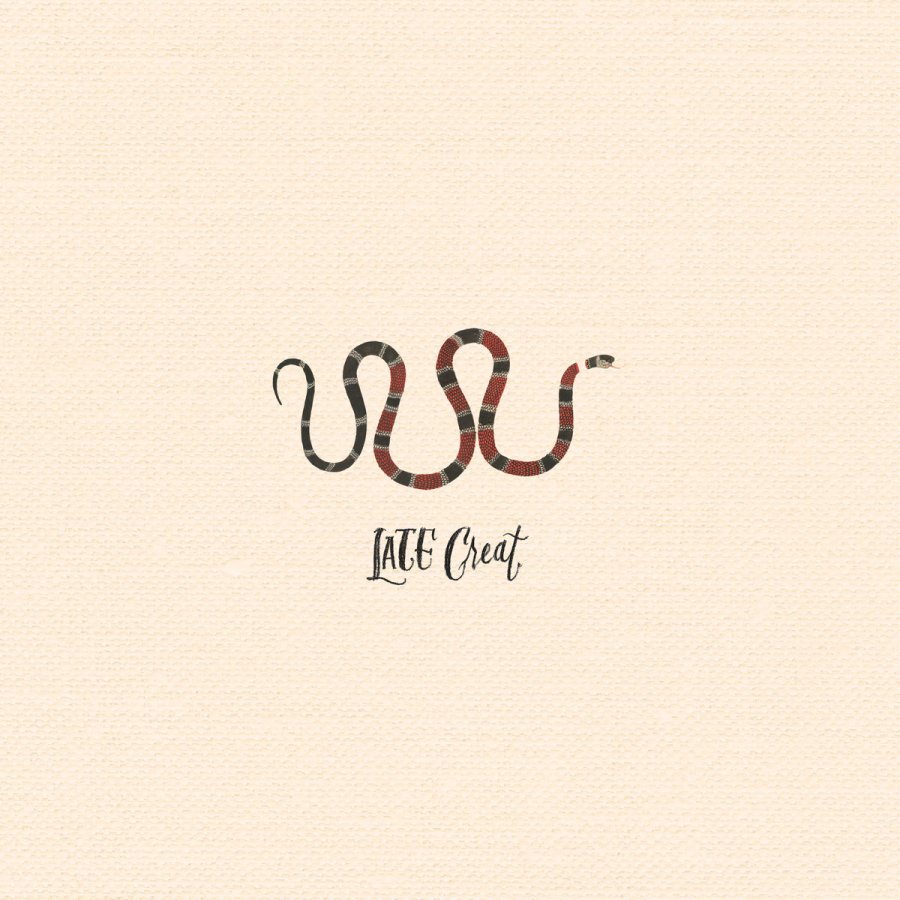
In trying to unpack Late Great as a listener, there are things that are apparent. One is that, on this album, Stevenson eschews fairly typical verse-chorus-verse song structures. As a listener, you can sometimes feel adrift as a result, unsure of the direction songs are going in, but it would be unfair to call Late Great unstructured or meandering in any way. In many ways, this is actually Stevenson’s most composed and confident record as a singer-songwriter – she plays with form, supported by a band made up of regular collaborators like Chris Farren and Jess Rosenstock. Songs will occasionally begin fairly stripped-back and then develop, but what sounds like the peak may not always be so. You might think you have a chorus, but what is in fact an increase in intensity before things shift again. Tracks like Late Great change sonically mid-way through, and moments of quiet around the mid-point of the album are sandwiched between some of the ‘fuller’ tracks. The snake on the cover of the album winds, and opening song #1 makes frequent lyrical references to rollercoaster – Late Great is not a serpentine, up-and-down album experience, but there seems something deliberate in its temperate sense of unpredictability, an attempt to perhaps reflect the likewise fluctuating nature of relationships themselves. In a brief interview with New Noise Magazine preceding the release of Late Great, Stevenson said that, at the time of writing the album, “[her] life was falling apart and changing, and also blossoming and becoming beautiful.” You do get this sense of change conveyed throughout the album – it is a record of endings and beginnings, with moments of clarity, regret, acceptance, and understanding. It navigates a monumental life experience – it is not supposed to be straightforward.
This was an album I wanted to understand myself, to unpack, partly as a Stevenson fan, but also as someone who has experienced separations of their own. I did feel like songs such as Domino and Not Us were painfully relatable (and they will be to anyone who has seen a relationship end), but Late Great is perhaps not a universal break-up record. I can’t say I’ve found myself in a legal office signing papers, which Stevenson sings about with such emotion on Middle Love– “a click of a pen / and the stroke of a hand / and there’s no longer you and me.” I think the word ‘devastating’ is a strong adjective thrown around a lot these days, but Middle Love is quietly devastating, especially in it’s very sudden and abrupt ending, a tight two minutes. Devastating in its delivery, and its choice of language too – “terrorists” is another strong word to use, but it’s how Stevenson describes herself and her ex-husband on the song. It’s a far cry from the “idiots” she describes other couples as on Not Us.
Stevenson’s vocals here, on Middle Love and Not Us, are incredibly affecting, and what I have yet to touch on yet is her voice, which is as beguiling as ever. Late Great at first seems a little more reserved, in that Stevenson doesn’t push as much as she did on records like The Big Freeze, but she is no less engaging as a vocalist. On Short & Sweet, I’m reminded of Adrianne Lenker’s recent album Bright Future, mic’d close, intimate, the slight fuzz of studio ambience audible. On Domino, there is a slight husk to Stevenson’s voice, the song a little darker in style, the lyrics much more direct and to-the-point (“I know you never loved me / but you said you did / you said, you said”). There are certainly songs here where Stevenson does warble and push, as with the finish of opener #1 and then second track I Want to Remember it All, her vocal gymnastics matching the intensity of her lyrics. Throughout, instrumentation matches her delivery well, be it subtle and restrained, or bold and dynamic. The addition of strings to #1 and Late Great are nice touches, also. Late Great is Stevenson’s most diverse record instrumentally – she jokes in interviews about wanting songs like Honey to “sound like a thousand guitars,” and she balances that sonic explosivity with sparser arrangements well.
So, Late Great is a stellar listen even if not reading into the lyrical themes on the album. But read into them I still am, after several listens. It’s perhaps a result of having spent so much time with The Big Freeze, an album I still listen to with rapt attention at least once a month. Earlier this year, I read All Fours by Miranda July, a novel still floating around the best-sellers list, in which a middle-aged woman plans to take a cross-country road trip only to vacation in a nearby motel, reflecting on family, marriage, and aging, amongst other themes [I won’t go into them here, but would recommend the novel]. I couldn’t help but think of All Fours during songs like Can I Fly for Free?, on which Stevenson ponders her new reality as a co-parent – “If one of us has to be hard / I’ll volunteer myself” – ending with the refrain of “There’s no going back on what I did / Can I fly for free?”. I Couldn’t Sleep may not take place in a motel room, but with All Fours on my mind, it’s where I imagined it playing out. In it, Stevenson’s lyrics are somewhat vague – it’s hard to know if she is writing about the early “firework” days of a past relationship, the giddy, excitable honeymoon period that keeps a person awake, or, starting new with someone else after coming out of a long-term relationship, the tentative first steps and the anxiety of the unfamiliar (“I keep fixing on wall meets ceiling / and I’m relieved I’m not feeling much of anything”). It seems this second interpretation is more likely. There are certainly lyrics like these where I want to be able to get a little closer to the core narrative here, again, perhaps after spending so many hours with July’s novel; the lyrics on Late Great are just cryptic enough that they feel secretive in a sense, and that Stevenson is not laying everything on the table – which is, of course, fair. She has always been a somewhat abstract lyricist, and leans into that again at times here. She ranges between perspectives in a way that captures the complexity of the situation – on Short & Sweet she sings, “It’s nobody’s error / I’ll be just fine,” on Instant Comfort: “I was a picture of what you wished you wanted.” It’s perhaps Honey that is the most self-critical – “get aboard my sinking ship / It’s empty, honey, don’t think about it,” and later, “my love’s hard won / but when it’s won, it’s hard to love me.”
All of this is to say that Late Great is an album that could be dissected and analysed textually, but then again, which doesn’t need to be. Even ignoring the lyrical content, this is a rich and luscious record, which continues Stevenson’s run of exceptional albums. When Late Great reaches the final two tracks, the title track and #1 (2) the latter of which concludes with what almost feels like a lullaby couplet (“The sunflower heads, standing there all soaking wet / Say their prayers and go to bed”), the reprise a sombre full-circle closing, there is a sense of having been on a rollercoaster of sorts – to return to that opening idea. Despite the events it details, there is catharsis and a ‘moving through,’ a healing of sorts, and we end the album in a relatively positive place – “I am who you met / I am true to who I am … / I’m standing alone / but I’m standing.” What we have with Late Great is another record in which Stevenson tackles a personal and weighty topic, and again does so with outstanding grace. I’m confident that it’s an album I’ll be coming back to regularly.
Rating: 9/10
*
*
Thank you for reading. I don’t post reviews on this site often anymore. Aside from Late Great, here are *some* other albums I’ve been enjoying recently, all from the first half of 2025:
- Adult Mom – Natural Causes
- Antony Szmierek – Service Station At The End Of The Universe
- Athletics – What Makes You Think This Is How It All Ends?
- Backxwash – Only Dust Remains
- billy woods – GOLLIWOG
- Black Country, New Road – Forever Howlong
- Black Foxxes – The Haar
- The Callous Daoboys – I Don’t Want to See You in Heaven
- caroline – caroline 2
- Cheekface – Middle Spoon
- Deafheaven – Lonely People With Power
- Emma-Jean Thackray – Weirdo
- Ethel Cain – Pervets
- FKA Twigs – EUSEXUA
- Home Is Where – Hunting Season
- Ichiko Aoba – Luminescent Creatures
- Jane Remover – Revengeseekerz
- Japanese Breakfast – For Melancholy Brunettes (& sad women)
- key vs. locket – i felt like a sketch
- L.S. Dunes – Violet
- Little Simz – Lotus
- Lucy Dacus – Forever Is A Feeling
- Mac Miller – Balloonerism
- MIRAR – Ascension
- Moontype – I Let the Wind Push Down On Me
- Moving Mountains – Pruning of the Lower Limbs
- Natalia Lafourcade – Cancionera
- Orthodox – A Door Left Open
- Panda Bear – Sinister Grift
- Pup – Who Will Look After The Dogs?
- Samia – Bloodless
- Shearling – Motherfucker, I am Both: “Amen” and “Hallelujah”
- SPELLLING – Portrait of My Heart
- Spiritbox – Tsunami Sea
- Thornhill – BODIES
- Viagra Boys – viagr aboys
- Whitechapel – Hymns in Dissonance
- Xinwenyue Shi – 灰太陽
- you, infinite – Self-titled
 Craig Reviews Music
[…] Laura Stevenson – Late Great [note: the only album I reviewed this […]